
As I write this article on December 1, 2025, more than four months have elapsed since the FAA announced the MOSAIC final rule during EAA AirVenture, on July 22. It’s been more than two years since the FAA published its Notice of Proposed Rulemaking on MOSAIC, otherwise known as Sport Pilot 2.0, and more than 20 years since the FAA launched Sport Pilot 1.0 in 2004. During those two decades, the flight training industry only managed to produce about 7,000 sport pilots – a drop in the bucket when compared to the more than 170,000 private pilot certificate holders currently listed in the FAA’s database. Why so few sport pilots under version 1.0 of the rule? According to industry talking heads, the main reason is that sport pilots were limited to only flying two-seat light sport aircraft, or LSAs. Their solution in version 2.0? Allow sport pilots to fly non-LSA aircraft including our Cessna two and four seat single engine aircraft. Sounds great, right? Well, sure it does. More access for more pilots. A spokesperson for EAA has often been quoted as touting MOSAIC as “an enabling rule” that will allow student pilots to earn their wings “in half the time, for half the cost, and have all the fun.”
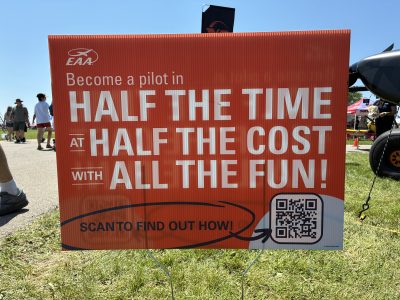 Well, not to be a Debbie Downer, but here’s the problem with all that. First, it’s a flat out lie. Sport pilots are not currently earning their certificates in “half the time” of private pilots. Not even close. According to the FAA’s own data, which I obtained earlier this year through a Freedom of Information Act request, sport pilot students report an average of about 80 hours of total flight time when applying for their practical test, compared to private pilot students who report an average of about 100 hours. Last time I checked, 80 is not half of 100, and it’s four times the minimum number of hours (20) required for a sport pilot certificate.
But that’s not even the biggest problem with MOSAIC. The whole half price thing is just a bunch of marketing garbage. The real problem is that the FAA regulatory guidance that allegedly “enables” flight instructors to authorize solo flight for student pilots in non-LSA aircraft under MOSAIC is flawed, making it legally impossible for us to do our jobs. Yet many flight schools out there are doing it anyway because the industry talking heads say it’s OK. Well, it’s not OK. I’ve done extensive research into this and produced detailed presentations and videos on the problem, but here’s the nickel version of the regulatory glitch in Sport Pilot 2.0.
FAR 61.23 was updated to read:
https://www.ecfr.gov/current/title-14/chapter-I/subchapter-D/part-61/subpart-A/section-61.23
61.23 Medical certificates: Requirement and duration.
(a) Operations requiring a medical certificate. Except as provided in paragraphs (b) and (c) of this section, a person—
(3) Must hold at least a third-class medical certificate—
(i) When exercising the privileges of a private pilot certificate, recreational pilot certificate, or student pilot certificate, except when operating under the conditions and limitations set forth in § 61.113(i);
(c) Operations requiring either a medical certificate or U.S. driver’s license.
(1) A person must hold and possess either a medical certificate issued under part 67 of this chapter or a U.S. driver’s license when—
(i) Exercising the privileges of a student pilot certificate while seeking sport pilot privileges in an aircraft meeting the performance limits and design requirements of § 61.316 other than a glider or balloon;
As a flight instructor, it’s my responsibility to provide a student pilot with the required training and endorsements prior to their first solo flight. It is the student’s responsibility to ensure they comply with the limitations set forth by the instructor via the required endorsements. But to determine if a student pilot needs to hold a FAA medical certificate to solo one of my airplanes as a student pilot, I need to first determine if that student pilot is “seeking” a sport pilot certificate or a private pilot certificate. But how? There is no regulation in Part 61 that segregates “sport pilot students” from “private pilot students” – a student pilot is someone who holds a Student Pilot Certificate. In the eyes of the FAA they are all the same. Student Pilot Certificates are plain vanilla and are not issued with the certificate sought, or the category and class of aircraft to be flown, like a Private Pilot Certificate is issued with the Airplane – Single Engine Land designation. It’s just a generic Student Pilot Certificate.
It’s important to remember that under Sport Pilot 1.0, you didn’t need a FAA medical certificate to act as pilot in command of a Light Sport Aircraft, regardless of the pilot certificate you held. Therefore, sport pilots (or sport pilot “seekers”) could fly LSAs without a medical by default. If you had a medical because you were “seeking” a private pilot certificate or you already held a higher level of certificate, and you wanted to fly a LSA because you thought they were cool, great. But you didn’t need the medical. Now, under Sport Pilot 2.0, the FAA has decoupled sport pilots from the airplanes they fly and made it possible for sport pilots or “sport pilot seekers” to fly other aircraft like my Cessna 150, 152 or 172 (see FAR 61.316). So how do I legally differentiate a sport pilot “seeker” from a private pilot “seeker” when evaluating a student pilot for solo in one of my aircraft? Where is the official FAA guidance? (Spoiler alert: there isn’t any.)
When I’ve posed this question to various industry “experts” and other pilots on social media, I’ve gotten various theories including “well, we made it work under Sport Pilot 1.0 and nothing has changed, so don’t worry about it.” One of the “hacks” that flight instructors have used to officially designate their students as “sport pilot seekers” is a reference to 61.89(c) which now reads:
61.89 General limitations.
(c) A student pilot seeking a sport pilot certificate must comply with the provisions of paragraphs (a) and (b) of this section and may not act as pilot in command—
(1) Of an aircraft other than an aircraft meeting the performance limits and design requirements of § 61.316;
(2) At night;
(3) At an altitude of more than 10,000 feet MSL or 2,000 feet AGL, whichever is higher;
(4) In Class B, C, and D airspace, at an airport located in Class B, C, or D airspace, and to, from, through, or on an airport having an operational control tower without having received the ground and flight training specified in § 61.94 and an endorsement from an authorized instructor;
(5) Of an aircraft without having received the applicable ground training, flight training, and instructor endorsements specified in § 61.327 (a) and (b).
Let’s break this down. First, paragraphs (a) and (b) of 61.89 apply to all student pilots, regardless of the certificate they are seeking. It’s paragraph (c) that sport pilot advocates point to as the lynch pin, the golden nugget of validity to determine that a student pilot is in fact “seeking” a sport pilot certificate and therefore does not need a FAA medical certificate to solo. But here’s the problem with that. First, if a student pilot solos without a medical at a non-towered airport, the endorsement of 61.89(c)(4) would not exist. Second, most flight instructors would hesitate to authorize their student to solo at night, regardless of what certificate they are seeking. Third, there are very few places in the county where a student pilot would be in a position to need to solo at an altitude above 10,000 feet MSL Finally, and most importantly, is the provision of sub-paragraph (5). FAR 61.327 applies only to pilots who already hold a Sport Pilot Certificate, not a Student Pilot Certificate. You cannot give the 61.327 endorsement to a student pilot because it doesn’t apply to them.
https://www.ecfr.gov/current/title-14/chapter-I/subchapter-D/part-61/subpart-J/section-61.327
61.327 Are there specific endorsement requirements to operate an aircraft based on VH?
(a) Except as specified in paragraph (c) of this section, if you hold a sport pilot certificate and you seek to operate an aircraft meeting the performance limits and design requirements of § 61.316 that is an airplane with a VH less than or equal to 87 knots CAS you must—
(1) Receive and log ground and flight training from an authorized instructor in an airplane that has a VH less than or equal to 87 knots CAS; and
(2) Receive a logbook endorsement from the authorized instructor who provided the training specified in paragraph (a)(1) of this section certifying that you are proficient in the operation of aircraft that is an airplane with a VH less than or equal to 87 knots CAS.
(b) If you hold a sport pilot certificate and you seek to operate an aircraft meeting the performance limits and design requirements of § 61.316 that has a VH greater than 87 knots CAS you must—
(1) Receive and log ground and flight training from an authorized instructor in an aircraft that has a VH greater than 87 knots CAS; and
(2) Receive a logbook endorsement from the authorized instructor who provided the training specified in paragraph (b)(1) of this section certifying that you are proficient in the operation of aircraft with a VH greater than 87 knots CAS.
(c) The training and endorsements required by paragraph (a) of this section are not required if you have logged flight time as pilot in command of an airplane with a VH less than or equal to 87 knots CAS prior to April 2, 2010.
There are dozens of other problems with MOSAIC but this is the biggest one in my opinion. I am not willing to risk my certificate or the reputation of my business just to be trendy and hop on the MOSAIC bandwagon. We play by the rules and when it comes to MOSAIC, the rule has holes in it so large that you could fly a Boeing 747 through them. In a nutshell, Sport Pilot 2.0 is a hot mess and I’m not touching it with a 10-foot pole until the FAA cleans it up. I’m not holding my breath on that.