
Flight training is expensive – there’s no way of getting around it. But if you’re willing to work hard and get creative, you can save a substantial amount of money and still achieve your goal of becoming a pilot. But first, a reality check how much it costs. The answer depends on your objective. If your goal is to just fly for fun with family and friends, then all you need is a private pilot certificate, and that’s going to run you about $20-30K. If you want to take it to the next level and earn your instrument rating, which will let you fly through the clouds and in lower visibility, that will cost about another $20K. If your goal is to earn a living as a pilot, then the next step is to earn your commercial pilot and flight instructor certificates, for about another $20K. So the total cost to go from “zero to hero” with Holladay Aviation is about $60-70K.
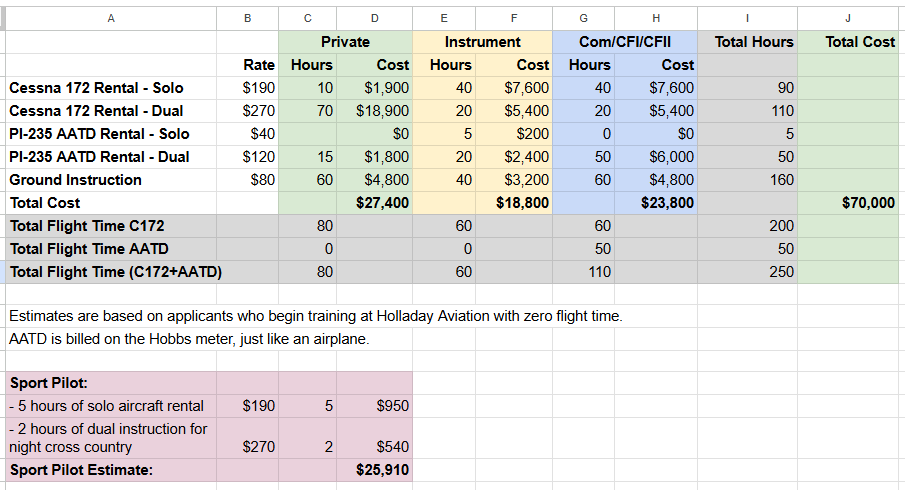
Now that you know how much all of this costs, let’s dive into ways that you can keep these costs as low as possible without sacrificing safety, quality or fun!
#1. Don’t get a loan to pay for flight training! Save up instead.
Getting an educational loan of any kind is a gamble like putting a stack of Benjamins on the roulette wheel in Vegas. Why? Because there is no guarantee that you’ll walk away from the experience with anything other than a lighter wallet. Questions you need to ask yourself before you sign up for a loan include: How will you repay the loan if you don’t get a flying job after you complete the program? What happens to the loan if you can’t complete the training program? What if you change your mind halfway through the program?
One of the largest providers of flight training loans in the U.S. is Sallie Mae. They used to be a government sponsored college loan program, but became a private lender in 2014. Still, Sallie Mae generally only works with Part 141 flight schools, where you will generally spend lots more earning your certificates than if you train under Part 61. If you’ve never heard of Part 141 or have questions about the differences between a Part 61 and a Part 141 flight school, you may want to check out the blog post I wrote on the subject, it’s a real eye opener.
Private aviation loans like those offered through companies like AOPA Finance, Stratus Financial or Meritize typically have high interest rates that are similar to credit cards. If you’re unable to find a job after earning your flight instructor certificate, you’ll have a really hard time paying back that loan and building the flight time you’ll need to qualify for a more lucrative airline job. Like I said, educational loans are a huge gamble.
A more conservative, fiscally smart choice is to save up the money for flight training and keep working while you train. Personally, I worked full-time throughout all of my training, which spanned nearly 4 years, from my first lesson in August 2001 through my initial flight instructor practical test in May 2005. I was extremely lucky to have had some first-class mentors and instructors during that time and beyond, who not only taught me how to be a safe pilot and instructor but how to be a savvy businesswoman.
There are lots of ways to sock away cash quickly for large life purchases including a flight training program:
- Stop eating out all the time. Cook your own meals at home and pack a lunch.
- Quit drinking alcohol and smoking cigarettes. This one should be a financial no-brainer, and will also improve your health.
- Make your own coffee at home instead of buying it at Starbucks or another fast food chain.
- Pay for everything you can with a credit card that offers cash rewards on your purchases, and of course, pay that credit card balance in full each month.
In just 2 years almost anyone with a full time job can save enough money to earn a private pilot certificate. We tell our customers to budget $60K for a zero to CFI program with us, and we recommend saving at least one-third of that, or $20K, before you begin training. That should pay for your private pilot certificate. Then, we recommend continuing to work your full-time job to replenish your training fund.
#2. Be diligent about studying and come to your flight lessons well prepared.
I cannot emphasize this enough. You’ve probably heard the phrase “time is money” and this is especially true when it comes to flight training. When you are paying a flight instructor by the hour, your objective should be to spend as little time with him or her as possible. You will be more likely to achieve the objective of the lesson if you study the material thoroughly in advance.
#3. Use a simulator throughout your training and fly with a safety pilot during instrument and commercial training.
This one’s a no-brainer for the customer, but many instructors don’t use sims with their students because, you guessed it, the instructor doesn’t get to log any flight time during a sim lesson. That’s not the case here at Holladay Aviation. We encourage our students to use the sims as much as practical, and incentivize our instructors to do the same. The math is simple for you as a student. The FAA allows up to 20 hours of simulated instrument training to be logged using an Advanced Aviation Training Device like our Elite PI-235 AATD. You can also use sims at home or at our flight school as much as you want to learn and practice your skills, even as a student pilot! Check out our flight sims page for more details.
If you’re working on your instrument rating, once you’ve learned instrument procedures with a CFII on the sim and in the airplane, you can then go out and fly with another private pilot acting as your safety pilot to log additional simulated instrument time toward the 40 hours you’ll need to qualify for the instrument rating. This can be a really fun way to practice IFR flying and learn valuable crew resource management skills. If you chose to exercise this option as a Holladay Aviation customer, you’d save $80/hour in instructor fees for every hour of simulated instrument time you log with a safety pilot. Do this for 10 hours and you just saved yourself $800!
But before you hop in your airplane with a random private pilot and throw on the Foggles, there are several important things to consider. Download our FREE Safety Pilot Guide to learn more.