
In December 2025, I wrote that, based on the available information we had at the time, Holladay Aviation would not offer sport pilot training in our Cessna aircraft even though the new FAA MOSAIC rule allowed us to do so. First, the back story. The FAA announced the MOSAIC final rule during EAA AirVenture, on July 22. It’s been more than two years since the FAA published its Notice of Proposed Rulemaking on MOSAIC, otherwise known as Sport Pilot 2.0, and more than 20 years since the FAA launched Sport Pilot 1.0 in 2004. During those two decades, the flight training industry only managed to produce about 7,000 sport pilots – a drop in the bucket when compared to the more than 170,000 private pilot certificate holders listed in the FAA’s database. Why so few sport pilots under version 1.0 of the rule? According to industry talking heads, the main reason is that sport pilots were limited to only flying two-seat light sport aircraft, or LSAs. Their solution in version 2.0? Allow sport pilots to fly non-LSA aircraft including our Cessna two and four seat single engine aircraft. Sounds great, right? Well, sure it does. More access for more pilots. A spokesperson for EAA has often been quoted as touting MOSAIC as “an enabling rule” that will allow student pilots to earn their wings “in half the time, for half the cost, and have all the fun.”
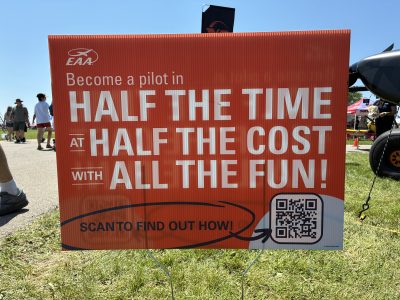 Well, here’s the problem with all that. First, it’s a flat out lie. Sport pilots are not currently earning their certificates in “half the time” of private pilots. Not even close. According to the FAA’s own data, which I obtained in 2025 through a Freedom of Information Act request, sport pilot students report an average of about 80 hours of total flight time when applying for their practical test, compared to private pilot students who report an average of about 100 hours. Last time I checked, 80 is not half of 100, and it’s four times the minimum number of hours (20) required for a sport pilot certificate.
One of the technical issues I had with the rule had to do with the wording of a requirement in FAR 61.89 which now reads:
61.89 General limitations.
(c) A student pilot seeking a sport pilot certificate must comply with the provisions of paragraphs (a) and (b) of this section and may not act as pilot in command—
(1) Of an aircraft other than an aircraft meeting the performance limits and design requirements of § 61.316;
(2) At night;
(3) At an altitude of more than 10,000 feet MSL or 2,000 feet AGL, whichever is higher;
(4) In Class B, C, and D airspace, at an airport located in Class B, C, or D airspace, and to, from, through, or on an airport having an operational control tower without having received the ground and flight training specified in § 61.94 and an endorsement from an authorized instructor;
(5) Of an aircraft without having received the applicable ground training, flight training, and instructor endorsements specified in § 61.327 (a) and (b).
Let’s break this down. First, paragraphs (a) and (b) of 61.89 apply to all student pilots, regardless of the certificate they are seeking. It’s paragraph (c) that sport pilot advocates point to as the lynch pin, the golden nugget of validity to determine that a student pilot is in fact “seeking” a sport pilot certificate and therefore does not need a FAA medical certificate to solo. But here’s the problem with that. First, if a student pilot solos without a medical at a non-towered airport, the endorsement of 61.89(c)(4) would not exist. Second, most flight instructors would hesitate to authorize their student to solo at night, regardless of what certificate they are seeking. Third, there are very few places in the county where a student pilot would be in a position to need to solo at an altitude above 10,000 feet MSL.
Finally, and most importantly, is the provision of sub-paragraph (5). FAR 61.327 is the regulation that allows sport pilot (and presumably student pilots who are sport pilot “seekers”) to fly our Cessnas with only a driver’s license and not a FAA medical. It requires specific training to operate an aircraft with a Vh (maximum cruise speed) of more than 87 knots, which includes our Cessna 150s, 152 and 172s.
https://www.ecfr.gov/current/title-14/chapter-I/subchapter-D/part-61/subpart-J/section-61.327
61.327 Are there specific endorsement requirements to operate an aircraft based on VH?
(a) Except as specified in paragraph (c) of this section, if you hold a sport pilot certificate and you seek to operate an aircraft meeting the performance limits and design requirements of § 61.316 that is an airplane with a VH less than or equal to 87 knots CAS you must—
(1) Receive and log ground and flight training from an authorized instructor in an airplane that has a VH less than or equal to 87 knots CAS; and
(2) Receive a logbook endorsement from the authorized instructor who provided the training specified in paragraph (a)(1) of this section certifying that you are proficient in the operation of aircraft that is an airplane with a VH less than or equal to 87 knots CAS.
(b) If you hold a sport pilot certificate and you seek to operate an aircraft meeting the performance limits and design requirements of § 61.316 that has a VH greater than 87 knots CAS you must—
(1) Receive and log ground and flight training from an authorized instructor in an aircraft that has a VH greater than 87 knots CAS; and
(2) Receive a logbook endorsement from the authorized instructor who provided the training specified in paragraph (b)(1) of this section certifying that you are proficient in the operation of aircraft with a VH greater than 87 knots CAS.
(c) The training and endorsements required by paragraph (a) of this section are not required if you have logged flight time as pilot in command of an airplane with a VH less than or equal to 87 knots CAS prior to April 2, 2010.
I did not see how a flight instructor could provide a student pilot, who holds a student pilot certificate, with an endorsement which is clearly intended for pilots who hold a sport pilot certificate. So I wrote to the FAA. I waited more than six months for an answer, but finally got one at the end of March. Here’s what FAA said:
The FAA disagrees there is a regulatory problem. Section 61.89(c) permits student pilots seeking a sport pilot certificate to act as pilot in command when conducting solo operations in an aircraft that satisfies § 61.316 performance limits and design requirements. Section 61.89(c)(5) speaks to ground training, flight training, and instructor endorsement requirements, not what pilot certificate you must possess.
Make and model specific student pilot instructor endorsements permit a person seeking a sport pilot certificate to operate aircraft that meet § 61.316 as PIC (solo), as clearly referenced in § 61.89(c)(1).
So even though I still think the whole sport pilot rule is a bit of a convoluted hot mess, at least now I have proof from the FAA that this key required endorsement is legit if someone wants to “seek” a sport pilot certificate in one of my Cessnas.
Now, for the reality check on flight time requirements and costs. As I said earlier, the sport pilot certificate is not half the hours or half the cost of a private pilot certificate. Furthermore, if you seek a sport pilot certificate with us at Holladay Aviation, you can expect to receive the same instrument training as a private pilot student, and some night flight training, even though the FAA doesn’t require it. Why? Because it’s the right thing to do. In reality, you’re not going to save much time or money earning a sport pilot certificate. Here’s a quick summary of the pros and cons of the sport pilot certificate vs. a private pilot certificate:
Pros:
- No FAA medical certificate required. I get it. We’re all about less government intervention in our lives. But if you’re avoiding getting a FAA medical because you don’t think you could pass the exam, or you’re taking a bunch of meds that you think might disqualify you, you might want to think twice about flying airplanes. You can expect to have a talk with us about your physical and mental health.
- No night flight training required. Look, I don’t fly much at night either. But I know how to land after dark if I have to for some reason. I want you to be prepared to fly at night, even if you choose not to.
Cons:
- You can only fly with one passenger even if you’re renting my four seat Cessna 172. This is one of the dumbest parts of MOSAIC, in my opinion. Makes absolutely no sense.
- You can’t fly into Class C or B airspace without specific training or endorsement.
- You can’t get an instrument rating.
- If you choose to “upgrade” to a private pilot certificate one day to avoid the other cons, you’ll have to take another check ride. That’s real expensive.
So… that’s the latest on the sport pilot situation.